.png)
Dynamic Pricing for Miami Airbnbs: How to Maximize Revenue Year-Round

Miami Airbnb earnings vary widely. The average host earns about $38,220 a year (AirROI, 2026). Some earn double that. A few clear triple. Same city. Same platform. Very different outcomes. The gap is not the property. It is not the neighborhood, the pool, or the view. It almost always comes back to one thing: how the pricing was handled.
Most hosts pick a number, post the listing, and wait. Then Art Basel week rolls in, Miami Beach nightly rates jump up to 70% (AirDNA), and that entire revenue window passes them by without a single adjustment.
The hosts earning at the top are not smarter or luckier. They just treat their Miami Airbnb like a business. They price around events, respond to slow months, and stay ahead of what the market is doing right now.
That gap has a name. It is called “Dynamic Pricing”. This guide breaks it down month by month, across Miami, Fort Lauderdale, and Hollywood, so you know exactly when to push rates up, when to pull back, and when to pivot entirely.
Why Static Pricing Loses Money in Miami
Most hosts approach pricing the same way. They look at what nearby properties charge, pick a number somewhere in the middle, and call it done. It feels safe and reasonable.
It is also one of the most consistent ways to underperform in this market.
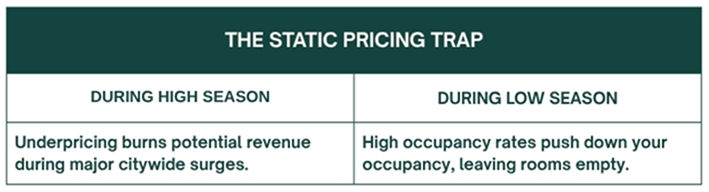
The Flat Rate Problem
Miami is not a flat market. Miami Beach nightly rates usually go up in winter. Come down in late summer. This means if a host uses the same rate all year, they might miss out on extra money during peak season, or the price might be too much when it's low season.
The Event Problem
Miami runs on a packed calendar: Art Basel, Ultra Music Festival, The Grand Prix, and Spring Break. Each one creates a short, sharp demand spike that flat pricing completely ignores.
And this is not just a Miami problem. Fort Lauderdale and Hollywood run their own peak windows, too. February is Fort Lauderdale's strongest month. Hollywood peaks in February and March. Three cities, three separate pricing opportunities, and all sitting inside the same South Florida market.
A host on flat pricing during any of these windows is leaving real money behind. Not because their property is not good enough. Because their rate never moved.
Where Smart Pricing Falls Short
Most hosts assume Airbnb's built-in Smart Pricing solves this, but it does not. Airbnb earns from booking fees. More bookings at lower prices means more fees for the platform, even if you take home less. Smart Pricing is built to fill calendars. It is not built to maximize what lands in your account.
Tip: Use it as a starting floor if you need a baseline. However, never treat it as a full strategy.
The hosts who make more than the market rate do not let Airbnb set their property prices. They use a pricing plan that changes according to what's happening in the market now, not what it did six months ago.
That is exactly what professional Airbnb management in Miami handles on a daily basis. The next part explains how they do it month by month.
Miami Airbnb Pricing 2026: A Month-by-Month Revenue Calendar
Most hosts think about pricing in two buckets. Peak season and off-season. Although that’s not enough. Miami's short-term rental revenue shifts every single month, and treating the whole year as two halves means missing the windows where the real money is made.
Here is how to think about each stretch of the year.

Peak Season: December Through April
This is when Miami Airbnb rates climb, and demand stays strong across the board.
December opens with Art Basel. It is one of the most powerful demand events on Miami's calendar. Nightly rates across Miami Beach spike significantly during that first week alone. If your pricing has not moved ahead of the event, early bookers will lock in your standard rate, and you will have no room to adjust.
January and February bring the snowbird crowd. Longer stays, steadier demand, and guests who plan well in advance. Fort Lauderdale peaks in February, with top-quartile listings earning over $400 per night on average. If you manage properties across South Florida, this is the month when Fort Lauderdale often outperforms Miami on occupancy.
March is Miami's strongest month overall. Spring Break and Ultra Music Festival hit at the same time. Demand across Miami, Hollywood, FL, and Fort Lauderdale rises together. This is the month where the gap between a well-priced listing and a flat-rate listing is most visible.
April brings the Grand Prix. The Formula 1 race draws an international crowd with high spending power. Properties near Brickell, Coconut Grove, and downtown Miami see some of their strongest nightly rates of the year during this window.
Shoulder Season: May and June
Demand starts to soften after the Grand Prix, but it does not disappear.
May still carries momentum, especially with the FIFA World Cup 2026. Miami is confirmed to host seven matches. Miami Short-term rental demand for match days has already been tracking above prior year levels. Hosts who build their dynamic pricing Miami Airbnb strategy around confirmed match dates now will be ahead of the market when those dates arrive.
June is a transition month. Longer minimum stays work well here. A five or six-night minimum helps avoid single-night gaps that leave dead days in your calendar and drive down your overall Airbnb revenue in Miami.
Off-Season: July Through September
This is where most hosts give up on strategy. They drop rates, accept whatever bookings come in, and wait for winter.
The hosts who consistently outperform do something different. A proper Miami Airbnb off-season strategy means shifting focus to guest segments that are still active. Remote workers looking for a month-long base. Corporate relocations. Guests displaced by weather events in other parts of Florida. These are real booking segments that fill calendars during the slowest stretch of the year.
Miami Airbnb seasonality data shows September is consistently the softest month. That makes it the most important month to have a plan for, not the month to go quiet. Your goal during this stretch is to maximize Airbnb revenue Miami by targeting the right guest, not by chasing the wrong rate.
October and November
Demand starts building again before most hosts notice. Snowbirds begin planning early. Forward-looking travelers are already locking in December dates.
This is the right time to raise rates ahead of the Airbnb peak season Miami, not after it arrives. Properties in Hollywood, FL, and Fort Lauderdale that position early in October regularly capture stronger December occupancy than those that wait.
If you want to understand how a property management company in Miami tracks and adjusts for each of these windows, the next section covers the specific factors that drive those daily pricing decisions.
Dynamic Pricing Explained: Behind the Scenes

Most people hear "dynamic pricing" and imagine a tool that raises rates when demand is high and drops them when it is slow. That is part of it. But there is more happening underneath.
Dynamic pricing pulls real-time data from multiple sources at once. It tracks what competing listings in your neighborhood are charging, how fast similar properties are booking, what events are on the local calendar, and how far out a guest is booking. All of that gets processed together, and your rate adjusts. Not once a month. Daily.
Here is what that looks like in practice. Miami's average booking lead time sits at around 36 days. A smart pricing setup holds rates firm when forward demand looks strong and makes controlled adjustments when dates are approaching, and the calendar still has gaps.
Airbnb pricing tools like PriceLabs, Beyond, and Wheelhouse handle this automatically. But the tool is only as good as the strategy behind it. A platform with no event rules will miss Art Basel entirely. A system with no rate floor will slash prices just to fill empty nights.
That is the gap between a host who "has dynamic pricing on" and one running an actual Miami Airbnb pricing strategy. The first has a tool. The second has a system.
RevPAR is the number that shows the difference. Miami's market median sits at $127. Top-performing properties run significantly higher. Occupancy alone does not get you there. Rate discipline does.
To see how Atlantikos manages pricing across Miami, Fort Lauderdale, and Hollywood, start with a free revenue estimate.
Ready to Stop Leaving Revenue Behind?
Dynamic pricing is a decision that gets made every single day. And in Miami, one missed Art Basel window or one underpriced Grand Prix week quietly costs more than most hosts ever add up.
The owners' earnings at the top are not doing this alone. They are not checking competitor rates every morning or manually adjusting calendars around every event. They have a team that does it for them, one that knows this market well enough to act before the window opens, not after it closes.
If you own a property in Miami, Fort Lauderdale, or Hollywood, that is what Atlantikos takes care of through our Airbnb management services. Pricing, guests, compliance, maintenance. Everything, every day, without it taking over your time.
Curious what your property could earn? Start with a free revenue estimate.


Comments